Wei Li Lab research
We develop computational and experimental methods to measure, model, and engineer genome function.
Our lab combines AI, CRISPR-based genome engineering, and single-cell genomics to study how coding and non-coding elements shape human physiology and disease.
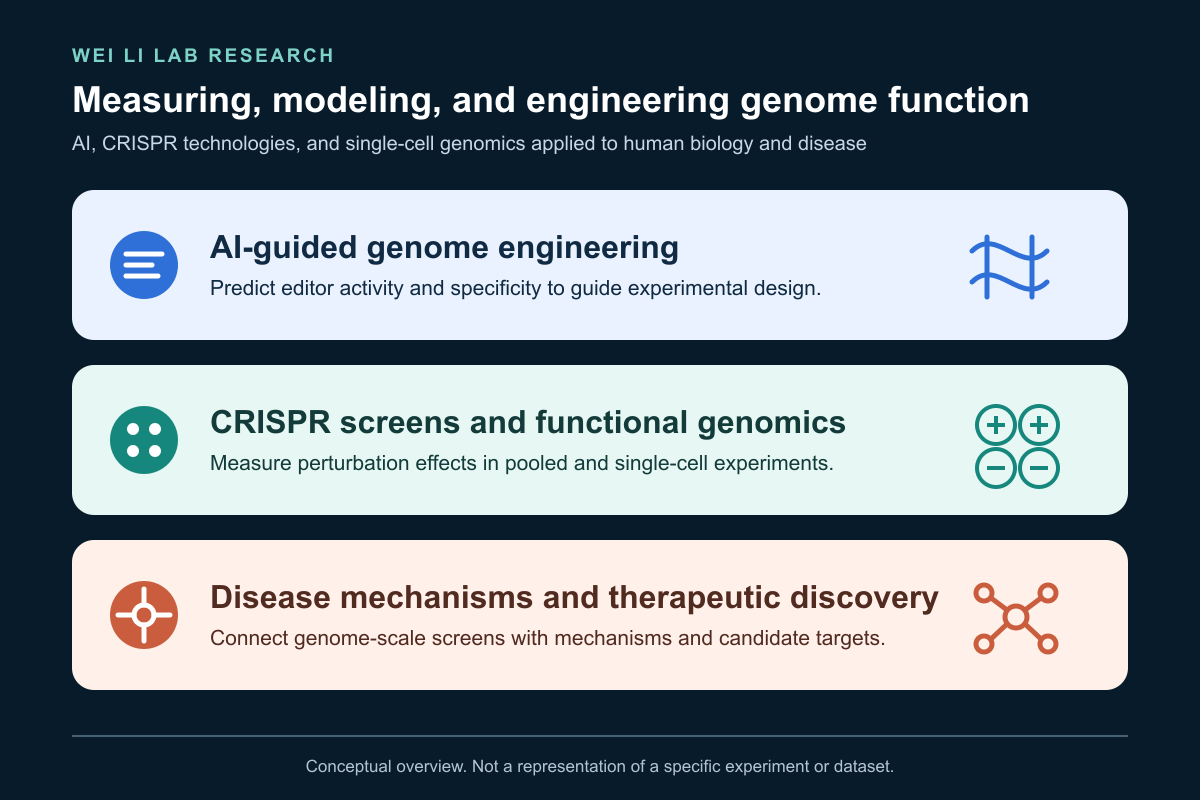
Research pillar 1
AI-guided genome engineering
Genome editors are powerful research tools, but their activity and specificity depend on guide sequence, molecular context, and delivery. We develop computational models that help explain these effects and guide experimental design.
DeepCas13 uses machine learning to predict Cas13d guide activity from sequence and RNA structure. We also develop models for base editing and other CRISPR systems. In collaborative work published in Nature Biomedical Engineering, we examined intrinsic host-RNA targeting by Cas13 and its implications for viral-vector delivery.

Research pillar 2
CRISPR screens and single-cell functional genomics
We develop methods to analyze pooled and single-cell CRISPR screens. MAGeCK and MAGeCK-VISPR support quality control, hit identification, and comparisons across experimental conditions. scMAGeCK models the effects of gene and regulatory-element perturbations from Perturb-seq and related datasets.
Our perturbation-response score (PS) framework measures variation in how individual cells respond to a perturbation. PS supports dose-response analysis and helps identify biological factors associated with heterogeneous responses. The work was published in Nature Cell Biology in 2025.

Research pillar 3
Disease mechanisms and therapeutic discovery
We work with experimental and clinical collaborators to apply genome-scale perturbation screens to human disease. These studies connect screening results with mechanisms that can be tested in disease-relevant models.
HIV-1 latency
Genome-wide CRISPR screens identified combinations of latency-reversing agents and host factors that influence HIV-1 reactivation. The study confirmed synergy between established agents and identified CYLD and YPEL5 as additional candidate targets for latency reversal.
Endocrine-resistant breast cancer
CRISPR screens identified loss of CSK as a mechanism that promotes resistance in estrogen receptor-positive breast cancer. A second screen identified PAK2 as a synthetic-lethal vulnerability in CSK-deficient cells, suggesting a route to target resistant tumors.

Foundational contributions
Functional long non-coding RNAs
Working with Wensheng Wei’s laboratory at Peking University, we developed a paired-guide CRISPR strategy to delete non-coding genomic regions and screen for functional long non-coding RNAs.
Transcriptome assembly and expression analysis
Earlier work from the lab introduced computational methods for RNA-seq transcript assembly and expression analysis, including IsoInfer, IsoLasso, CEM, and ISP. This work established part of the computational foundation for our current studies of single-cell transcriptomes.